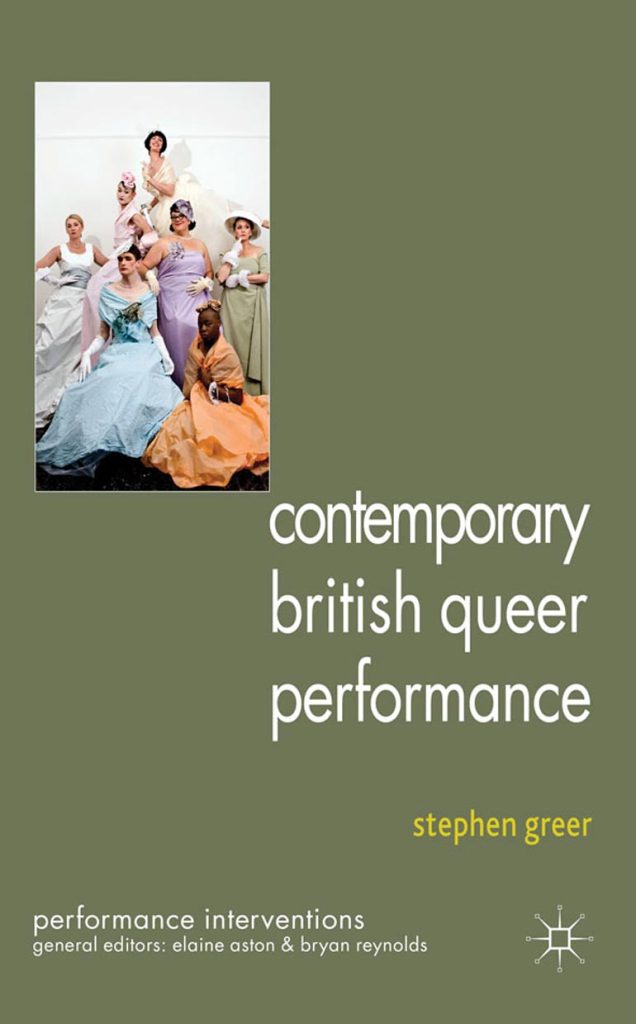
Contemporary British Queer Performance
Tracing a genealogy of politics and practice from early lesbian and gay theatre in the 1970s to the 1990s and beyond, this book explores how foundational debates concerning visibility, authenticity and representation have been transformed by the advent of queer theory and queer activism.
‘Stephen Greer’s study Contemporary British Queer Performance contributes not only to queer theories and performance studies but also to history and sociology, literary and theatre studies. It is exemplary in its interdisciplinary approach and delivers rich and valuable findings in a wide spectrum of performances’ – Theaterforschung
Available from Palgrave Macmillan.
What’s in the book?
Part I offers a theoretical and historical grounding for the understanding of contemporary practice: first describing key aspects of early queer theory and its implications for the study and production of performance, before turning to examine the foundational priorities and practices of Gay Sweatshop, the UK’s first gay theatre company.
Part II presents a series of contemporary case studies around specific areas of performance practice, asking where earlier claims to representation, visibility and difference have been taken up, re-ordered or abandoned through chapters exploring community and nation plays, theatre-in-education projects, developments in queer protest, and the rise of queer arts festivals.